
Guide
to Lunar Impact Flash Observing
By Dr Tony Cook
Email: atc @
aber.ac.uk

Work in Progress – please check back
periodically for revised versions of this web page
What is
a Lunar Impact Flash?
Lunar Impact
Flashes (LIFs) Happen when a meteoroid flying through space collides with the
Moon. Unlike meteors in the Earth’s atmosphere, which make shooting stars, on
the Moon 5 things happen: you instantly get a hemispherical crater form, ejecta
is thrown out at a few km/sec in a cone, there is a
seismic shock, you get a flash of light almost as bright as the Sun, and after
a while the hemispherical crater re-adjusts to be more
shallow.
From the
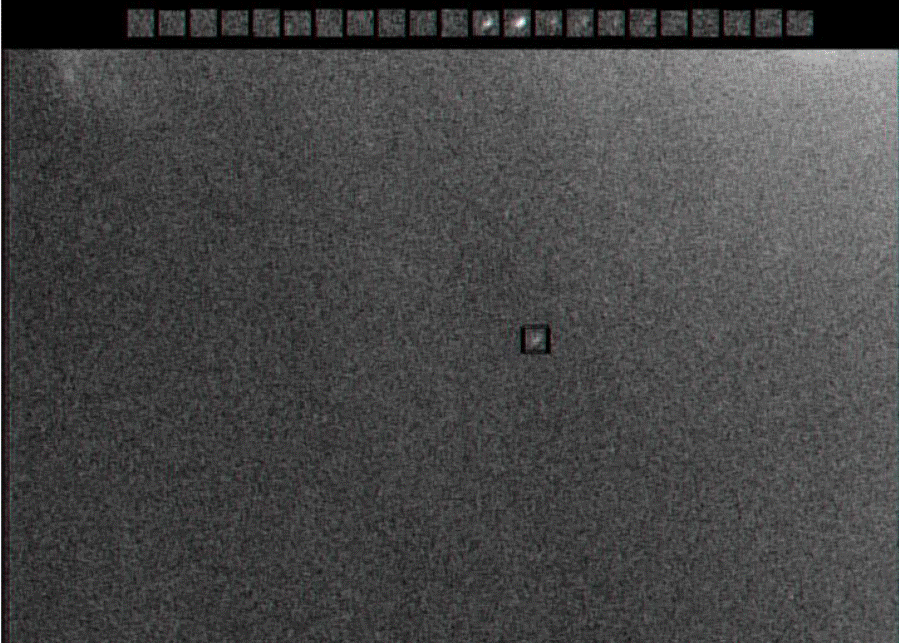
Earth, looking through a telescope you may see a tiny flash of light, on the
night (earthshine) part of the Moon, lasting
fraction of a second.
Observations
Made So Far:
The following two files are work in progress….
Observations of earthshine made: obs_time.xlsx
Observations of LIFS: LIF.xlsx
Observing
Equipment Needed:
Minimum requirement would be a scope of aperture 4.5”, though typically 8”-12” would be ideal. You can observe visually by looking at the dark side of the Moon i.e. earthshine, with a wide field eyepiece, but be sure to have an accurate time source to record any sighting of a flash, and perhaps a voice recording device to say when you saw the flash and how it appeared. For video observations, you can use a second hand (used) monochrome camera; perhaps something like a Watec 902H with analog composite video output. These cameras are ideal as they have extended near-IR sensitivity, which is the region of the spectrum that impact flashes are at their brightest. Alternatively many astronomers are now using USB 3.0 cameras which are capable of capturing video of earthshine directly e.g. the DMK or ASI1600 cameras – whatever you use make sure that it can video stars down to 10-11th magnitude at speeds of faster than 10 frames per second – you can bin pixels to achieve faster time resolution if you like. Please make sure that the camera does not average video frames over time, else you will reduce the sensitivity of detecting impact flashes and make the study of any light curves very problematic.
How to
Report a Lunar Impact Flash:
Please send me an email with the date, UT (if possible to the nearest sec), it’s approx. location on the Moon (if not lon and lat then the nearest feature), if possible its magnitude (compare with nearby stars), its duration in seconds, your country and nearest town.
In addition, if you have time, it would be really helpful to know details about your equipment, observing conditions etc e.g. size of scope, camera, area of Moon covered, was your scope tracking the Moon or stationary, what software you used (if any) to detect the flash. If you were observing visually, what colour was the flash – if any? Oh and don’t forget to send the discovery image – no need to send the whole video, but please add start and end UTs of the observation, even if you detected no flashes.
Resources:
LunarScan Impact flash detection software by Peter Gural – it is very useful to run more than one impact flash program over video as these all work in different ways. What one piece of software may detect, others may miss and vice versa.
ALFI Automated Lunar Flash Investigation software by Tony Cook is a simple program to find and highlight flashes in images of the Moon
FDS Flash Detection Software was developed by the NELIOTA observatory team, and works directly with Firecapture, detecting flashes at the telescope. The instruction manual is here.
UFOCapture has been used by the meteor community but can be used to look for impact flashes on the Moon. Various free trial versions exist on this web site.
VirtualDub – video capture software which is used in conjunction with the ALFI software
Lunar Impact Monitoring Programme at the NASA Marshall Spaceflight Centre
NELIOTA Lunar Impact Monitoring Programme, funded by ESA at the Kryoneri Observatory, Greece
MIDAS Lunar Impact Flash Project run by the University of Huelva, Spain
Marrakesh Lunar Impact Flash Observatory - Morocco
Earthshine & other lunar target Observing dates/UTs – if your observing site is not here, email me and I’ll add it
Lunar Impact Flash Catalogue – combines the impact flash results from all observing programmes
IOTA Occultation Prediction Software – occultations of stars by the Moon are useful magnitude calibration targets
ALPO Lunar Section Impact Flash Observing – run by Brian Cudnik
BAA Lunar Section – amateur lunar observing in the UK of which impact flash observing forms one of their activities
UAI Lunar Section – active team of lunar impact flash observers in Italy
Selenology Today – Geological Research group with some discussion on impact flash observing
Lunar Meteoroid Impacts and How to Observe Them – book by Brian Cudnik
First Lunar Impact Flash Seen from the UK on 2017 New Year’s day in this BBC report.
Author References:
Cook, A.C, (2012) Future Concepts for Impact Flash Observing, European Planetary Science Congress, held in Madrid, Spain, Vol. 7, EPSC2012-959.
Cook, A.C, (2017) ALFI – Automatic Lunar Flash Investigation, European Planetary Science Congress, held in Riga, Latvia, Vol. 11, EPSC2017-967.
Cook, A.C, Menzies, M.D., and Thorpe, D. (2017) Mapping Lunar Impact Flashes, European Planetary Science Congress, held in Riga, Latvia, Vol. 11, EPCS2017-971.
Menzies, M.D., Cook, A.C., Sposetti, S., Lena, R. and Iten, M. (2017) The Spatial Extent of Lunar Impact Flashes, European Planetary Science Congress, held in Riga, Latvia, Vol. 11, EPSC2017-968.
Sweeney, C., Thorpe, D. and Cook, A. (2018) The Spatial Distribution of Lunar Impact Flashes, European Planetary Science Congress, held in Berlin, Germany, Vol. 12, EPSC2018-1077.
Contact
Details:
Published: Dr Anthony Cook
Department of Physics
University of Aberystwyth
EmaiL: atc @ aber.ac.uk
Home Page: http://users.aber.ac.uk/atc
The information
provided on this and other pages by me, Tony Cook (a t c @ a b e r . a c . u k )
is under my own
personal responsibility and not that of Aberystwyth University. Similarly, any
opinions
expressed are my own and are in no way to be taken as those of A.U.